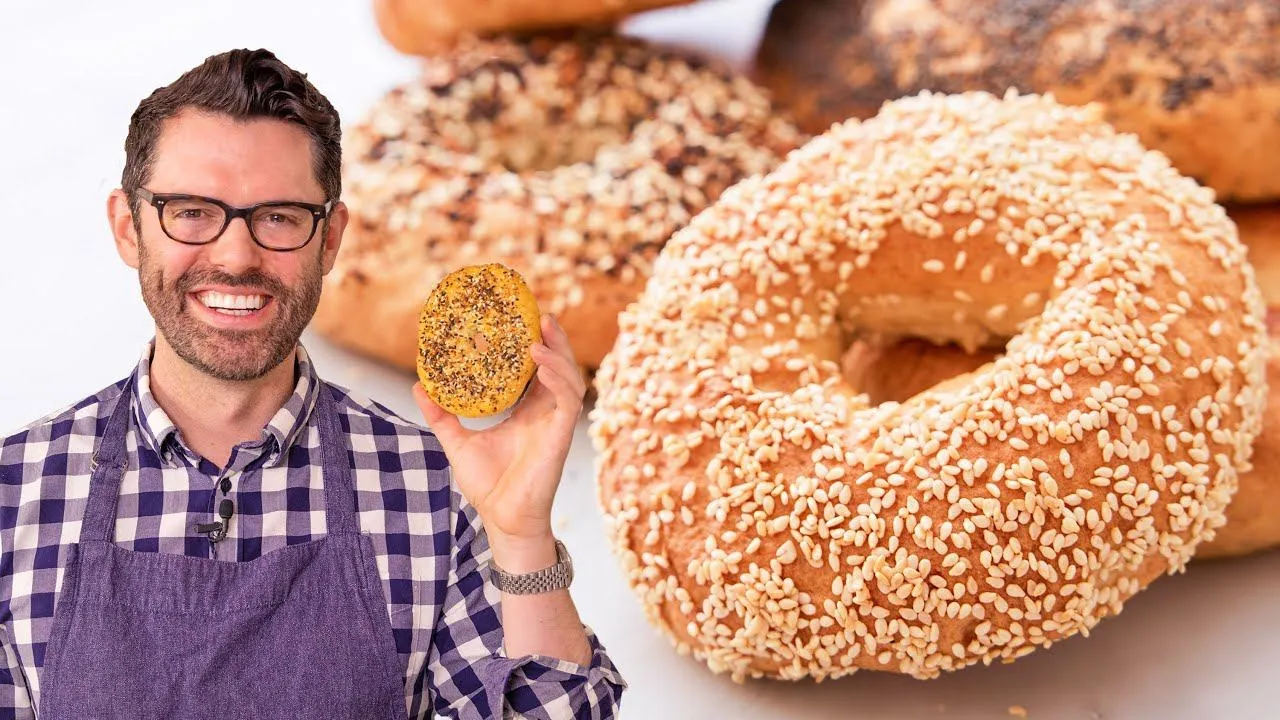
Easy Homemade Bagels
First off, in the bowl of your stand mixer add 1 and 1/2 cups (360 ml) of warm water between 110 and 100 °F. I’m also adding one packet of active dry yeast—that’s 2 and 1/4 teaspoons or ¼ ounce. By the way, you don’t need a stand mixer to make this; you can definitely make them by hand. I’ll give you instructions for that too.
To make them nice and happy you have a couple of options here. Traditional bagels should have some barley-malt syrup; it gives a signature flavor—one tablespoon now and some later on. It is not easy to find, so we’re going to use a substitute today: brown sugar. You could also use granulated sugar, agave syrup, or maple syrup; there are tons of different options, but you just want to add a little extra flavor to these guys.
Stir this up and let it hang out for 10 minutes until it’s nice and foamy. If you don’t see the foam, start over, because that means your yeast is dead. It’s so important that you actually see that foamy head.
Mixing the Dough
Ten minutes later we’re ready to start because this has a beautiful foamy head. Add 4 and 1/2 cups (540 g) of bread flour. I don’t want to use all-purpose in this because I want that nice chew; bread flour has a higher protein content and gives better consistency for breads like bagels.
Mix it up by hand first so the mixer isn’t working forever to incorporate the liquid. Once you have a nice shaggy mixture, pop on the dough hook if you’re using a mixer. If you’re going by hand, dump it onto your counter and knead 10–15 minutes until it’s silky.
Don’t forget the salt: two teaspoons. Increase to medium-low speed and let it go 10–15 minutes. At first it will be funky and inelastic, but it will become silky and start slapping the bowl.
The Windowpane Test
After about 8 minutes the dough is much smoother and more elastic. A few more minutes and you can stretch it so much that light passes through—that’s the windowpane test. Pop the dough into an oiled bowl, cover, and let it rise in a warm place for about an hour until doubled.
Shaping
Line two rimmed baking sheets with lightly greased parchment. Punch the dough down and divide it into eight pieces for large bagels (or twelve for smaller ones). Shape each piece into a ball by stretching the corners and rolling. Lightly flatten each ball, pinch a hole in the center, and stretch until the hole is about 2 inches across. Place on the prepared sheets about 2 inches apart. Loosely cover and let rest 20 minutes.
Boiling
Preheat the oven to 425 °F. Bring 3 quarts of water to a boil, then reduce to a simmer. Add 3 tablespoons brown sugar (or barley-malt syrup) and 1 teaspoon baking soda; this alkaline bath gives a chewier texture and golden crust. Boil each bagel about 1 minute per side, flipping carefully with a spider or slotted spoon. Drain, placing the prettier side up on the baking sheet.
Topping & Baking
Immediately sprinkle with your favorite toppings—everything seasoning, dehydrated onions, poppy seeds, etc. Bake at 425 °F for 15 minutes, then flip and bake 5–10 minutes more until nicely browned. Cool slightly, add a slather of cream cheese and your favorite toppings, and enjoy. Nothing beats a bagel fresh out of the oven: soft and airy inside, chewy and crisp on the outside.
Leave a Reply