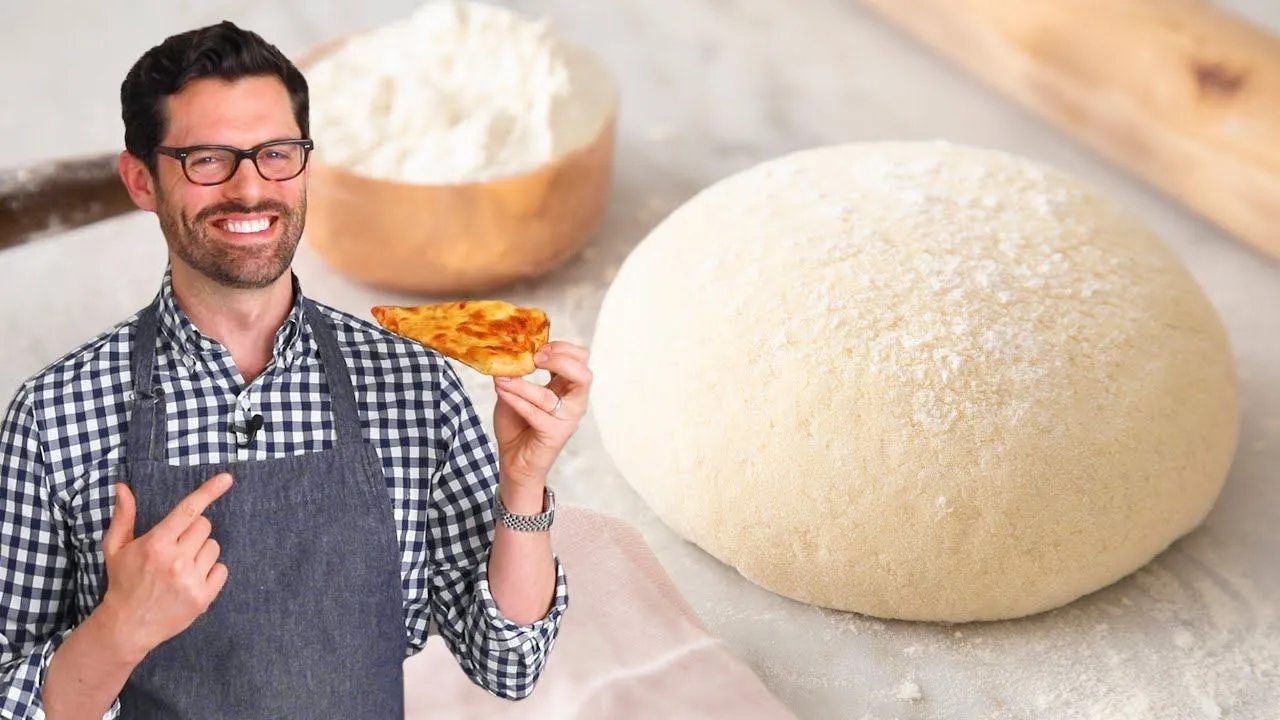
Pizza Dough Recipe
Have you been searching for the perfect homemade pizza dough recipe? It’s so easy, whips up really quick, and you can make pizza whenever you want.
This homemade pizza dough will be ready before you know it, so let’s get started.
Activating the Yeast
First off, we have to wake our little baby yeast up. They’re all tucked away in this package, basically like freeze-dried into little granules, and they need a nice warm environment to wake up in with a little bit of food. We want to use water that is warm—not cold, not hot. Cold won’t wake them up; hot will kill them. Go for about a hundred degrees. If you put your finger in, it should feel warm, not scalding hot.
I also like to use my mixing bowl, but first I warm it up by filling it up with hot water just because the glass is so cold it’ll sap the heat out of that water in an instant. Pour that out, and now I’m adding in three quarters of a cup of warm water between 100 and 110 degrees. I’m gonna add in half of a tablespoon of sugar—the remaining half will be used later—that’s the food. Now one package of active dry yeast. You could also use instant yeast for this as well. Pour that out, give it a quick stir, and cover this up. Let it hang out for like five minutes, maybe seven. You’re looking for little bubbles to form; that lets you know the yeast has woken up and that pizza dough is gonna be on its way.
Mixing the Dough
Okay, five or so minutes later, let’s take a peek. Oh, perfect—super frothy, bubbly. Those yeast are kicking.
I have two cups (240 grams) of all-purpose or double-zero flour, and I’m gonna add three quarters of a teaspoon of salt. That pizza dough needs some flavor. You could also add in like half a teaspoon of dried rosemary, oregano, any herb you like—even onion powder or garlic powder. You do you. Add the rest of the sugar, the remaining half tablespoon, and give it a whisk.
I’m taking out the stand mixer, but you could totally do this by hand. Make a little well in the middle; it gets messy, but you could use a wooden spoon. Attach the dough hook. If the dough is not coming together, just add a little bit more flour depending on humidity, measuring, etc. Go on low. At first you’re like, “Oh my gosh, this is going totally wrong,” but then it’s like, “Oh, it worked out perfect.” So just keep going; don’t lose faith.
Let the mixer do its thing for a couple minutes. You can add a bit more flour if it’s wet, or a little more water if it seems dry. You want a cohesive, slightly sticky ball.
Kneading and First Rise
Sprinkle a well-floured surface, turn the dough out, and knead briefly—just a minute or two—to finish activating the gluten. You want a smooth, bouncy ball that springs back when pressed.
Get a big bowl, add a few tablespoons of olive oil (or any vegetable oil), swirl to coat, plop the dough in, and turn it so the top is greased. Cover and leave in a warm, draft-free spot until doubled—about an hour. (No proofing drawer? Heat your oven to 120 °F, turn it off, and pop the bowl inside.)
Shaping the Pizza
Once risen, punch the dough down, turn it onto a lightly floured surface, and roll it out. Stretch it gently, keeping the middle thinner and the edge a bit thicker. Transfer to a baking sheet (or preheated stone if you have one). Fold or pinch the edge to form a rim, then give it a final stretch.
Topping and Baking
Lightly brush the surface with olive oil, especially the crust. Dock the dough with a fork to reduce large bubbles. Spread a thin layer of pizza sauce, sprinkle on low-moisture mozzarella (or whatever cheese and toppings you like), and bake at 425 °F for about 12 minutes, until the cheese is melted and golden. Keep an eye on it—ovens vary.
Slice, serve, and enjoy your homemade pizza!
Leave a Reply